
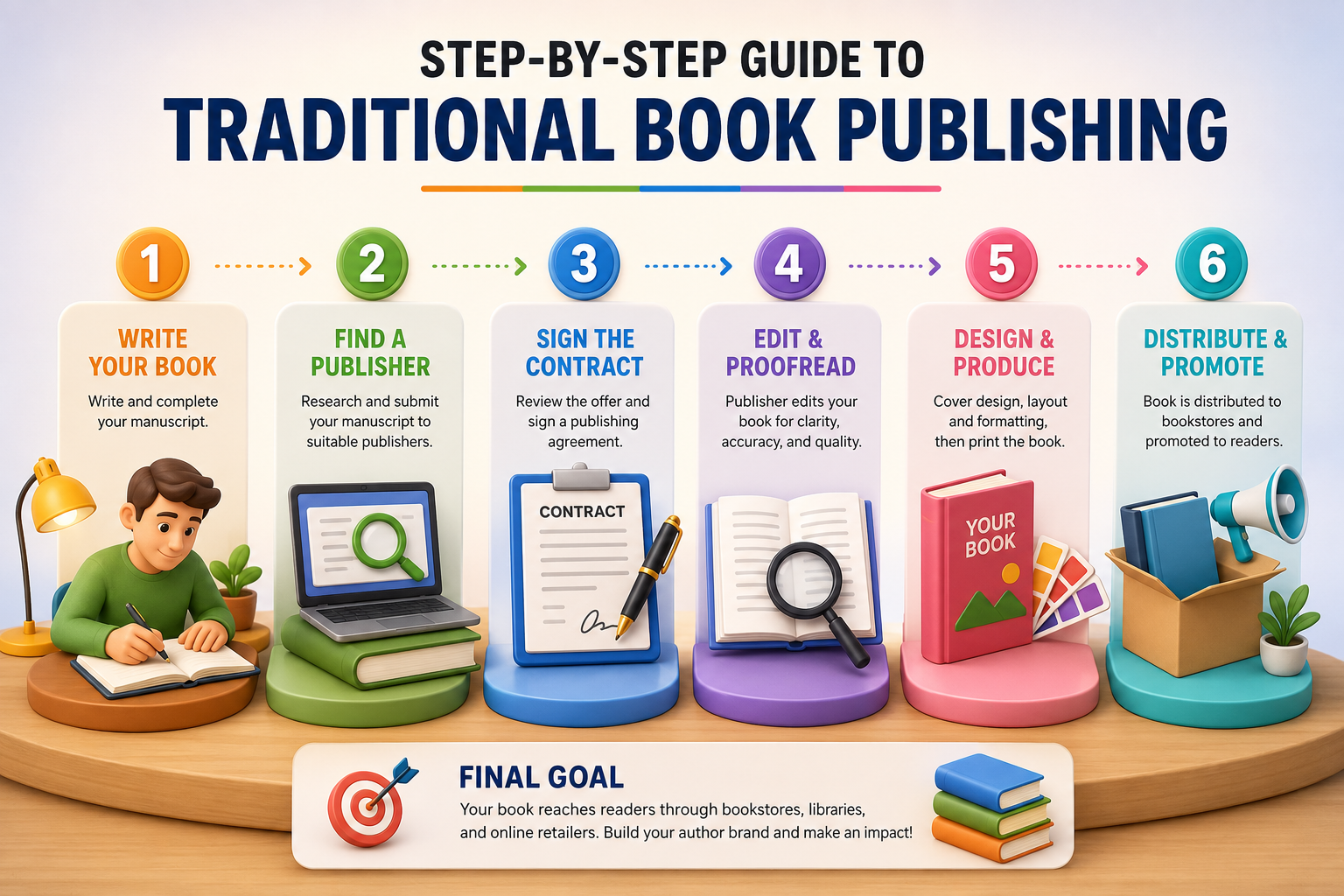
Traditional book publishing is the process of getting a book accepted, produced, distributed, and promoted by an established publishing house. In this model, the publisher usually handles editing, design, printing, distribution, and part of the marketing process.
Many authors still choose traditional publishing because it offers industry credibility, professional support, bookstore access, and wider distribution opportunities. However, it is also competitive and often takes time. This guide explains each major step, from completing your manuscript to submitting it, signing a contract, working with a publisher, and promoting your book after release.
What Is Traditional Book Publishing?
Traditional publishing means a publishing company accepts your manuscript and invests in producing the book. The author does not usually pay upfront for editing, cover design, printing, or distribution. Instead, the publisher earns money from book sales and pays the author royalties.
The process usually begins with a polished manuscript, followed by agent research, query submissions, publisher review, contract negotiation, editing, design, production, distribution, and marketing. The benefits include professional guidance, industry connections, bookstore placement, and publishing credibility. The challenges include rejection, long timelines, limited creative control, and lower royalty percentages compared to self-publishing.
Traditional publishing is best for authors who want industry validation, professional production, and access to established distribution channels. It can also be useful for writers who are willing to wait and improve their work through a highly selective process.
Complete and Polish Your Manuscript
Before submitting to agents or publishers, you need a finished manuscript. A first draft does not need to be perfect, but it must be complete. Once the draft is finished, revise it carefully for structure, clarity, pacing, consistency, and overall strength.
Feedback from beta readers can help you see how real readers respond to the book. They may point out confusing sections, slow chapters, weak arguments, or characters that need more development. After that, hiring a professional editor can make the manuscript stronger before submission.
Proofreading is also important. Agents and publishers do not expect every manuscript to be flawless, but too many errors can make the work seem unprepared. A polished manuscript shows professionalism and respect for the publishing process.
Research Literary Agents and Publishers
Literary agents are important because many traditional publishers do not accept direct submissions from authors. An agent represents your work, submits it to publishers, negotiates contracts, and helps guide your publishing career.
Start by researching agents and publishers in your genre. A children’s book agent may not be right for a business book, and a romance publisher may not accept memoirs. Study submission guidelines carefully because every agency and publisher may request different materials.
Avoid sending mass emails without personalization. Do not submit to publishers that do not handle your genre. Also, be careful when researching the best book publishers for new authors, because not every list online is accurate or suitable for your specific book.
Prepare Your Submission Package
A submission package usually includes a query letter, synopsis, and sample chapters. For nonfiction, it may also include a full book proposal.
A query letter is a short professional letter that introduces your book and yourself. It should include the title, genre, word count, hook, brief summary, and relevant author background. A strong query letter is clear, specific, and focused on why the book will interest readers.
A nonfiction book proposal usually includes the target audience, market analysis, chapter overview, author platform, competing titles, and sample chapters. Publishers want to know not only what the book says, but also who will buy it and why it matters now.
A synopsis summarizes the full book, including the ending. Sample chapters should be properly formatted, clean, and selected according to submission guidelines. Always follow instructions exactly, because poor formatting or missing materials can hurt your chances.
Submit Your Manuscript
When submitting, follow each agent or publisher’s guidelines carefully. Some ask for only a query letter, while others request sample pages, a synopsis, or a proposal. Sending the wrong materials can make the submission look careless.
Simultaneous submissions are usually acceptable unless guidelines say otherwise. This means you can submit to multiple agents at the same time. Keep a record of where you submitted, the date, and any responses.
Response timelines vary. Some agents reply within weeks, while others may take months. Rejection is normal in traditional publishing. Handle it professionally, revise when needed, and keep submitting.
Review and Sign a Publishing Contract
If a publisher offers a contract, review it carefully before signing. The contract may include advance payments, royalty rates, publishing rights, territory rights, deadlines, and marketing responsibilities.
An advance is money paid before publication and later earned back through sales. Royalties are the author’s percentage of each sale. Publishing rights explain what formats, languages, or territories the publisher controls.
Legal review is important because contracts can affect your book and future income for years. A literary agent or publishing attorney can help you understand the terms before you commit.
Work with the Publisher
After signing, the book moves through the publishing process. The publisher may assign developmental editors to improve structure, pacing, content, or organization. Copy editors then polish grammar, style, clarity, and consistency. Proofreaders review the final version for remaining errors.
The publisher also handles cover design and interior formatting. Authors may be asked for input, but final decisions often belong to the publisher. The final approval process may include reviewing edits, page proofs, cover concepts, and marketing materials.
A reliable book publishing service can help authors understand these stages before they enter the traditional process, especially if they are new to publishing expectations.
Printing and Book Distribution
Traditional publishers manage print publishing, eBook publishing, and sometimes audiobook production. They also help distribute books to bookstores, online retailers, libraries, wholesalers, and international markets.
Print distribution allows books to reach physical stores and libraries. eBook distribution makes the book available to digital readers. Global distribution can help books reach readers outside the author’s local market.
This wider access is one reason many writers still consider traditional publishing the best book publishing route for long-term credibility and reach.
Market and Promote Your Book
Even with a traditional publisher, authors still need to promote their books. Building an author website gives readers, media outlets, and event organizers one official place to learn about the author and the book.
Social media can help authors grow visibility, share updates, and connect with readers. Book reviews also matter because they build trust and support sales. Email marketing allows authors to communicate directly with their audience.
A book launch strategy may include interviews, podcasts, guest articles, launch emails, social media content, and review outreach. Authors comparing the best book publishers for new authors should also look at how much marketing support each publisher provides.
Common Challenges in Traditional Publishing
Traditional publishing is competitive. Many strong manuscripts are rejected because publishers must consider market fit, timing, sales potential, and list availability. The process can also take a long time, sometimes more than a year from acceptance to publication.
Authors may have limited control over cover design, title changes, release dates, and marketing decisions. Royalty rates are usually lower than self-publishing, but the publisher carries much of the production cost and industry risk.
Tips to Improve Your Chances of Getting Published
A high-quality manuscript is the foundation. Follow submission guidelines, personalize every query letter, and show that you understand the agent or publisher’s interests. Build your author platform through a website, email list, social presence, and useful content.
Stay patient and persistent. Traditional publishing often requires many submissions and revisions. Continue improving your writing skills, studying the market, and learning from feedback. A professional book publishing service can also help authors prepare stronger materials before approaching agents or publishers.
Traditional Publishing Checklist
- Finish your manuscript.
- Edit professionally.
- Research literary agents.
- Prepare a query letter.
- Write a synopsis.
- Submit your manuscript.
- Review your publishing contract.
- Complete the editing process.
- Support your book marketing.
- Launch your book.
Case Study: A New Author Who Stayed Prepared
A first-time novelist completed her manuscript and wanted to submit immediately. Instead, she spent three months revising, hired an editor, gathered beta reader feedback, and researched agents in her genre. She also created a simple author website before querying.
Her first round of submissions led to rejections, but several agents gave useful feedback. She revised again, improved her query letter, and submitted a stronger package. Eventually, one agent requested the full manuscript and offered representation. Her success came from preparation, patience, and professionalism.
Conclusion
Traditional publishing is a long but structured journey. Authors must complete a strong manuscript, polish it carefully, research agents and publishers, prepare submission materials, handle rejection professionally, review contracts wisely, and support marketing after publication.
Success in traditional publishing requires persistence, professionalism, and continuous learning. The authors who prepare each step carefully are more likely to earn attention, build credibility, and give their books the strongest chance in a competitive industry.
FAQs
What is traditional book publishing?
Traditional book publishing is a process where a publishing house accepts an author’s manuscript, produces the book, distributes it, and pays the author royalties from sales. The publisher usually manages editing, design, formatting, printing, and distribution.
Do I need a literary agent for traditional publishing?
Many traditional publishers require authors to work through a literary agent, especially larger publishing houses. An agent helps submit your manuscript, negotiate contracts, and guide you through the publishing process.
How long does traditional publishing take?
Traditional publishing can take a year or more after a manuscript is accepted. The timeline depends on editing, design, production, printing, distribution, and the publisher’s release schedule.
Why do traditional publishers reject manuscripts?
Traditional publishers may reject manuscripts because of weak writing, poor market fit, unclear audience, similar books already on their list, or limited sales potential. Rejection does not always mean the book has no value.
How can new authors improve their chances of getting published?
New authors can improve their chances by writing a polished manuscript, following submission guidelines, personalizing query letters, researching the right agents, building an author platform, and staying persistent through rejection.